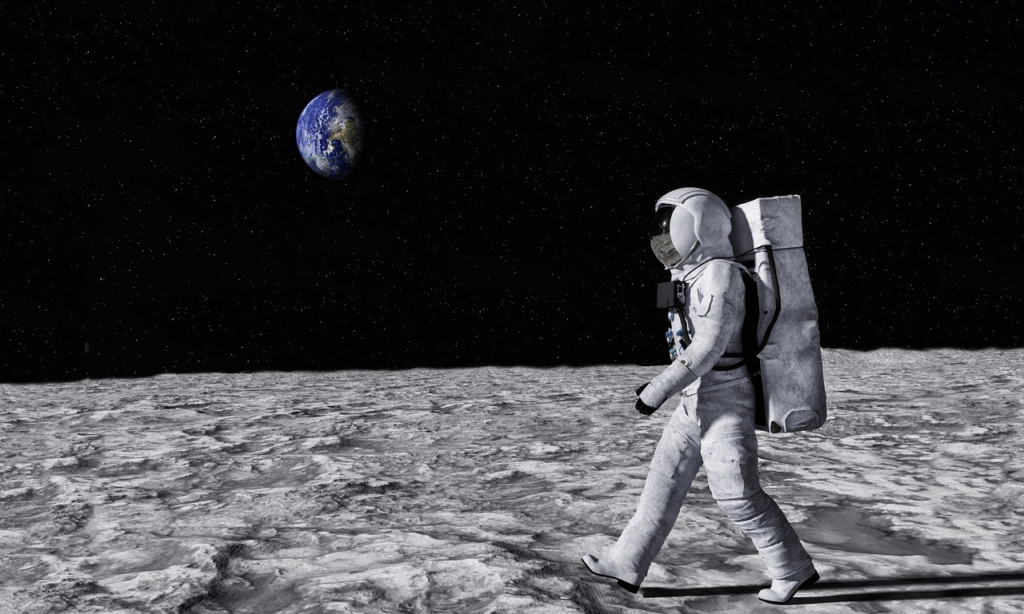
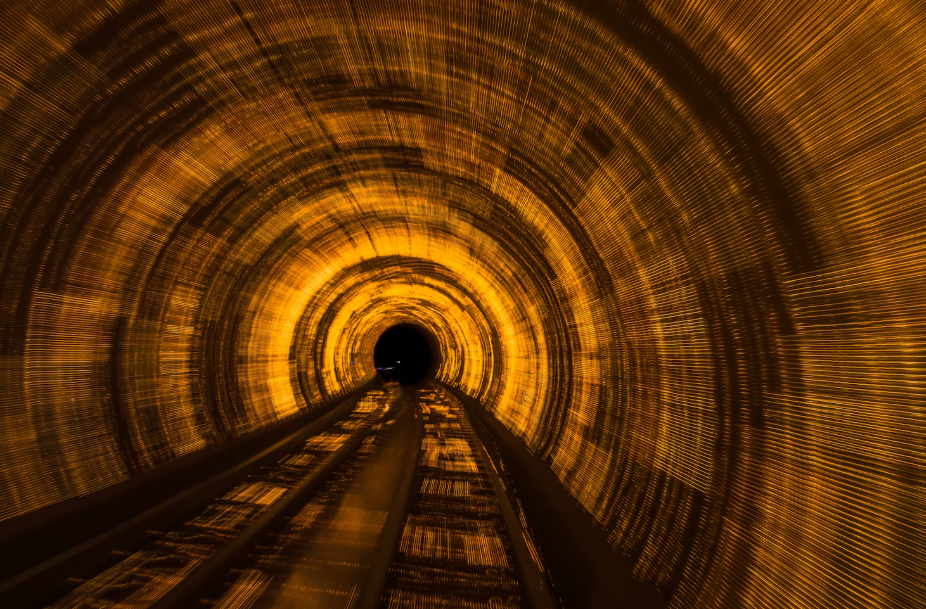
Imagine digging a tunnel straight through the planet, from one side to the other, and then jumping in. How long would it take to fall through? Would you come out the other side? And what would the ride be like?
This thought experiment, known as the “gravity tunnel,” is a favorite among physicists because it’s equal parts absurd and fascinating.
The Setup: A Perfect Tunnel Through the Planet
Let’s start with a few impossible assumptions: the tunnel is perfectly straight, lined so it doesn’t collapse, has no air resistance, and doesn’t fill with magma. In this imaginary world, gravity pulls you toward Earth’s center at first, then slows your fall as you approach the opposite side. It’s basically a planet-sized roller coaster.
The Science: Gravity in Action
When you first jump, gravity accelerates you at about 9.8 meters per second squared. You’d quickly reach incredible speed, around 17,000 miles per hour (27,000 km/h), as you near the planet’s molten core. But after crossing the center, gravity reverses direction, slowing you down until you come to a gentle stop right at the opposite surface.
If there were no air friction, you’d oscillate back and forth forever, passing through the Earth like a human pendulum.
Explore How Airplanes Stay Up — Simplified for the Curious for another approachable physics breakdown.
The Answer: About 42 Minutes
Physicists have calculated that the entire trip would take about 42 minutes from one side to the other, or roughly the length of a TV drama episode. This surprising number stays consistent whether you start in New York and end in Australia or anywhere else, thanks to the way gravity behaves inside a sphere.
That’s because gravity decreases linearly as you move toward the center. Hence, the motion follows the same mathematical rules as a simple harmonic oscillator, a swinging pendulum, or a vibrating spring.
The Realistic Version: Air Resistance and Heat
Of course, in reality, this trip would never happen. You’d burn up within seconds as temperatures approach 10,000°F (5,500°C) near the core. Even if you somehow survived the heat, air resistance would slow you down so much that you’d stop halfway and remain suspended near the center. The Earth’s pressure would crush any tunnel before you even got there.
For more bite-sized brain ticklers, see Everyday Math Tricks That Seem Like Magic.
The Hypothetical Fix: A Vacuum Tunnel
What if we lined the tunnel with super-strong materials and pumped out all the air? In that case, the fall becomes possible (in theory). Scientists have estimated that if you built such a vacuum tunnel and used magnetic levitation to eliminate friction, you could travel from one side of the Earth to the other in approximately 42 minutes, in line with the ideal scenario. You’d experience a few minutes of weightlessness at the midpoint before gravity pulled you back.
Why Physicists Love This Thought Experiment
The gravity tunnel isn’t just a fun “what if.” It’s a neat way to explore fundamental physics: gravity, motion, and energy conservation. It also demonstrates how predictable natural laws can be, even in extreme hypothetical scenarios. Some researchers have even modeled scaled-down “gravity tunnels” using magnetically levitated trains to simulate the concept in real life.
Curious about forces you don’t notice but feel daily? Don’t miss Invisible Forces You Encounter Every Day.
The Bottom Line
You’ll never get the chance to fall through the Earth, but if you did, the ride would take 42 minutes, follow a perfect rhythm of acceleration and deceleration, and end right where you started. It’s the ultimate physics daydream, and serves as a reminder that even the strangest ideas can teach us how the universe works.