For decades, scientists have considered tools to uniquely understand human behavior. Then we discovered chimpanzees using sticks to extract termites, crows fashioning hooks from wire, and dolphins using sponges to protect their snouts while hunting.
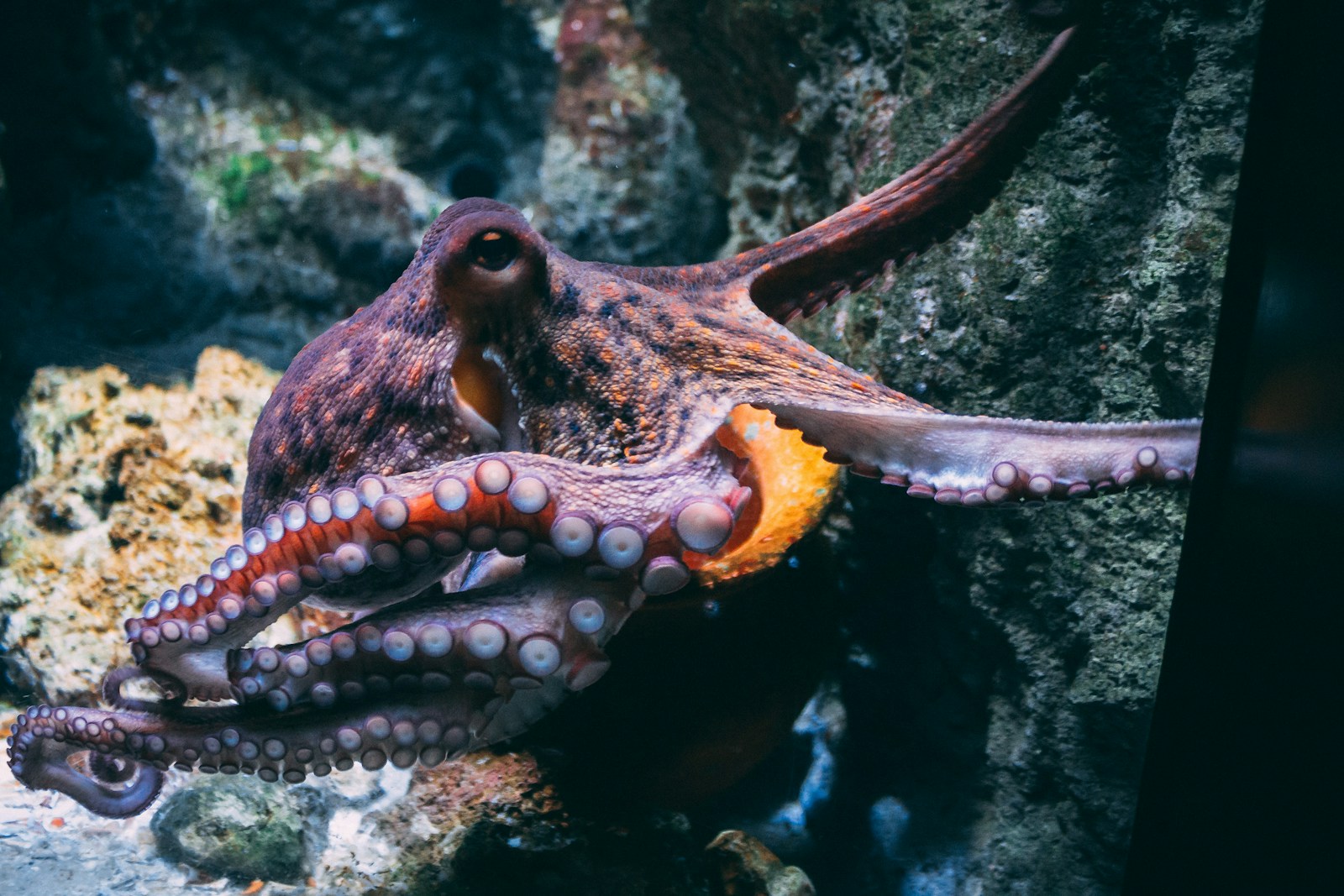
But perhaps the most fascinating tool user isn’t a mammal or bird at all. It’s a boneless, eight-armed creature whose brain evolved completely independently from ours: the octopus.
In 2009, researchers observed something remarkable off the coast of Indonesia. Veined octopuses carried coconut shell halves across the ocean floor, stacking them and reassembling them into protective shelters when danger approached. This wasn’t instinct or accident. It was deliberate, planned behavior—the hallmark of genuine intelligence.
Since then, scientists have documented octopuses using rocks as shields, wielding jellyfish tentacles as weapons, and even throwing objects at other octopuses during disputes. These behaviors force us to reconsider what intelligence actually means and whether our mammal-centric definitions have been too narrow all along.
This article explores the documented evidence of octopus tool use, what these behaviors reveal about cognitive abilities, and why octopus intelligence challenges our fundamental understanding of how minds can evolve.
Why Octopus Intelligence Challenges Our Assumptions
When we think of intelligent animals, we typically imagine creatures similar to us: primates, dolphins, elephants, all mammals with large, centralized brains. We’ve built our entire framework for understanding intelligence around vertebrate brain structures.
Octopuses break that framework completely.
They’re invertebrates, part of the mollusk family that includes clams and snails. Their last common ancestor with humans lived approximately 600 million years ago, before brains as we know them evolved. Yet despite this vast evolutionary distance, octopuses have independently evolved sophisticated cognitive abilities that parallel, and sometimes exceed, those of many mammals.
Here’s what makes octopus intelligence so extraordinary:
They have no bones. Unlike tool-using mammals and birds, octopuses have no rigid skeletal structure to leverage against tools. Every movement requires coordinated muscle control across a completely flexible body.
Their brains are distributed. Two-thirds of an octopus’s neurons aren’t in its brain at all—they’re in its arms. Each arm can “think” semi-independently, making decisions about texture, taste, and movement without input from the central brain.
They’re solitary. Most intelligent animals are social species where intelligence evolved to navigate complex group dynamics. Octopuses are loners who rarely interact with their own kind, yet they’ve still developed problem-solving abilities that rival social animals.
They’re short-lived. Most octopus species live only 1-2 years. They don’t benefit from extended childhoods or parental guidance. Every octopus must independently figure out survival strategies, which makes their tool use even more remarkable.
These factors make octopus intelligence fundamentally different from our own. Studying them is about recognizing that intelligence itself can evolve through completely different pathways.
Read More: Why Pigeons Are Smarter Than You Think
Documented Examples of Octopus Tool Use
Scientists have documented multiple instances of octopuses deliberately using objects as tools. Here are the most significant examples:
Coconut Shell Armor
The most famous example comes from research published in Current Biology by marine biologists Julian Finn, Tom Tregenza, and Mark Norman. They observed veined octopuses (Amphioctopus marginatus) in Indonesia, collecting discarded coconut shell halves from the ocean floor.
What makes this tool use, not just shelter-seeking, is the behavior sequence:
- The octopus finds coconut shells scattered on the seafloor
- It cleans and inspects them
- It carries them awkwardly across the ocean floor (walking on stilts with its arms while holding shells under its body)
- It transports shells to a new location
- It reassembles them into a protective sphere when threatened
The octopus is carrying these shells not because they’re immediately useful, but because they might be useful later. This demonstrates future planning, a cognitive ability once thought unique to humans and great apes.
Carrying coconut shells is also costly. The octopus moves slowly and awkwardly, making itself more vulnerable to predators. It only makes sense if the octopus can anticipate future benefit, which requires abstract thinking.
Rock Shields and Barricades
Multiple species of octopuses have been observed collecting rocks and arranging them as protective barriers around their dens. But they don’t just pile rocks randomly; they select specific sizes and shapes, positioning them to block entry points while maintaining visibility of their surroundings.
Some octopuses have been filmed holding rocks in their arms and using them as mobile shields while moving between hiding spots. This “shield-carrying” behavior demonstrates that they understand the rock’s protective function can be transferred to new contexts.
Jellyfish Tentacles as Weapons
In what might be the most creative example of octopus tool use, blanket octopuses (Tremoctopus) have been observed tearing tentacles from Portuguese man o’ war jellyfish and wielding them as weapons.
The octopus is immune to the jellyfish’s venomous nematocysts (stinging cells), but predators aren’t. By holding these tentacles while hunting or defending itself, the octopus gains a chemical weapon without producing its own venom.
This behavior demonstrates several cognitive abilities:
- Recognizing the jellyfish’s defensive properties
- Understanding those properties can be transferred to objects
- Planning to acquire weapons before they’re immediately needed
- Fine motor control to handle dangerous material without harming itself
Throwing Objects
Recent research using underwater cameras has captured octopuses throwing silt, shells, and algae, sometimes at other octopuses.
In a 2022 study published in PLOS ONE, researchers observed octopuses in Jervis Bay, Australia, using their siphons (the tubes they use for propulsion) to launch objects with apparent intent. Female octopuses threw material at males who were harassing them, and the throwing appeared deliberate rather than accidental.
While it’s debatable whether this counts as “tool use” in the traditional sense, it demonstrates that octopuses understand projectile motion and can use objects to affect their environment at a distance.
Read More: Deep Sea Creatures That Look Like Aliens
What Makes Tool Use a Sign of Intelligence
Not all tool use indicates high intelligence. Many animals use objects in instinctive, inflexible ways. A wasp that plugs its nest with a pebble isn’t demonstrating intelligence; it’s following genetic programming.
True tool use, the kind that indicates cognitive sophistication, has several markers:
Flexibility and Innovation
Intelligent tool use involves adapting behavior to new situations. The coconut shell octopuses demonstrate this; they didn’t evolve over millions of years to use coconuts (which were introduced to their habitat relatively recently by humans). They recognized the potential of a new object and innovated a use for it.
Future Planning
Carrying a tool to a different location for future use requires imagining scenarios that haven’t happened yet. This capacity for mental time travel was long considered uniquely human but has now been documented in great apes, corvids (crows and ravens), and octopuses.
Understanding Cause and Effect
Tool use requires grasping that manipulating object A will produce result B. The octopus carrying a jellyfish tentacle understands the causal relationship between the tentacle and predator avoidance.
Problem-Solving Transfer
Can the animal apply learned strategies to new problems? Octopuses demonstrate this repeatedly in laboratory settings, solving novel puzzles and generalizing solutions across different contexts.
Octopus tool use checks all these boxes, placing them in a small category of animals with genuinely sophisticated cognition.
The Octopus Brain: Radically Different from Ours
To understand how remarkable octopus intelligence is, you need to understand how alien their nervous system is compared to ours.
Distributed Intelligence
About 500 million neurons populate an octopus’s nervous system, roughly the same as a dog. But only 170 million are in the central brain. The rest are distributed across eight arms, with each arm containing about 40 million neurons.
This means octopus arms can make decisions independently. An arm exploring a crevice can identify food by taste and texture, decide whether to grab it, and execute complex movements, all without consulting the brain. The central brain sets general goals (“find food”), but the arms handle execution autonomously.
This is fundamentally different from vertebrate intelligence, where decisions originate from a centralized brain and flow through a hierarchical nervous system.
No Centralized Processing
Human intelligence relies on the prefrontal cortex, which integrates information and makes executive decisions. Octopuses have nothing analogous. Their intelligence emerges from the interaction between semi-independent processing centers.
Imagine trying to use a tool when each of your arms is making its own decisions, partly independently. The coordination required is staggering, yet octopuses manage it flawlessly.
Neural Flexibility
Octopus neurons are remarkably plastic, constantly forming new connections. This might explain their ability to solve novel problems without learned experience or parental teaching. Each octopus essentially builds its own neural pathways through trial and error.
What Octopus Intelligence Reveals About Evolution
The existence of octopus intelligence has profound implications for our understanding of cognition.
Convergent Evolution of Intelligence
Octopuses prove that intelligence isn’t exclusive to one evolutionary branch. Two completely different lineages, vertebrates and cephalopods, independently evolved similar cognitive capabilities through entirely different neural architectures.
This suggests intelligence is a convergent solution to environmental challenges. When survival requires flexibility, problem-solving, and adaptability, natural selection favors intelligent behaviors regardless of the starting point.
Intelligence Doesn’t Require Social Complexity
Most theories of intelligence evolution emphasize the role of social pressures, including navigating alliances, predicting others’ behavior, and coordinating group activities. But octopuses are solitary and still highly intelligent.
This suggests that intelligence can evolve purely from ecological pressures—dealing with diverse prey, evading predators, and navigating complex environments—without the need for social interaction.
Multiple Pathways to Cognition
If intelligence evolved independently in mammals, birds, and octopuses through different mechanisms, it suggests that cognition isn’t a single thing with a single path. There may be multiple forms of intelligence, each shaped by different evolutionary pressures and neural substrates.
This has implications beyond biology. If intelligence can emerge from radically different systems, it suggests artificial intelligence might also take forms we don’t yet recognize or understand.
Other Surprising Examples of Octopus Problem-Solving
Beyond tool use, octopuses demonstrate intelligence through various behaviors:
Escape Artistry
Octopuses in aquariums are notorious escape artists. They can unscrew jar lids, squeeze through impossibly small gaps, dismantle tank equipment, and even learn to turn off lights by squirting water at them.
These escapes aren’t random. Octopuses observe their environment, identify weak points, and execute multi-step escape plans. Some aquariums have documented octopuses leaving their tanks at night to raid neighboring tanks for food, then returning before morning.
Observational Learning
Octopuses can watch other octopuses solve problems and then replicate the solution. This social learning ability was previously thought to require complex brain structures that octopuses lack.
In laboratory experiments, octopuses that observed another individual opening a container to access food subsequently opened similar containers faster than octopuses without that observational experience.
Personality and Individual Differences
Octopuses display distinct personalities. Some are bold and exploratory; others are cautious and shy. They remember individual humans, responding differently to people who have fed them versus those who have annoyed them.
This individual variation suggests consciousness and subjective experience, though proving that scientifically remains challenging.
Play Behavior
Play is considered a marker of cognitive complexity because it serves no immediate survival function. Yet octopuses have been observed engaging in what appears to be play, repeatedly releasing objects into a tank’s current and catching them, seemingly for enjoyment.
Why We Need to Rethink How We Define Intelligence
Octopus intelligence forces uncomfortable questions about how we recognize and value cognition.
For decades, we’ve defined intelligence through a vertebrate lens: problem-solving, like primates; communication, like humans; and social structures, like wolves. These definitions are biased toward capabilities we possess.
But what if intelligence manifests differently in creatures whose evolutionary history diverged from ours 600 million years ago? What if distributed processing and embodied cognition represent equally valid forms of intelligence we simply don’t recognize?
The implications extend beyond octopuses. If intelligence can evolve through completely different mechanisms, it suggests:
We may be surrounded by forms of intelligence we don’t recognize because they don’t look like ours. Plant networks, fungal mycelium, and other systems may possess forms of information processing and problem-solving that we have not yet learned to identify.
Consciousness might not require the neural structures we thought essential. If a distributed nervous system can generate flexible, intentional behavior, consciousness might emerge from any sufficiently complex information-processing system.
Ethical frameworks need updating. If we base animal welfare solely on similarity to humans, we miss creatures like octopuses whose intelligence is profound but different. Several countries now recognize cephalopods as sentient beings requiring legal protection.
Conclusion
When an octopus carries a coconut shell across the ocean floor, it’s doing something remarkable, not just for an invertebrate, but for any animal. It’s planning ahead, imagining future scenarios, and using tools to solve problems that haven’t yet occurred.
This challenges everything we thought we knew about intelligence. It proves that minds can evolve through radically different pathways, that consciousness doesn’t require vertebrate brains, and that intelligence is far more diverse than our human-centric definitions suggest.
The octopus isn’t just smart for a mollusk. It’s genuinely intelligent in ways that force us to expand our understanding of what intelligence can be. And perhaps that’s the most important lesson: intelligence isn’t a single thing with a single path. It’s a spectrum of possibilities, emerging wherever evolution encounters problems that require flexible and creative solutions.
The next time you encounter an octopus, remember you’re not looking at a simple sea creature. You’re face-to-face with an alien intelligence, one that evolved on Earth but through a path so different from yours that its very existence challenges the boundaries of what we thought minds could be.
Read More: Animals With Superpowers You Wish You Had